 Smart
SmartEvery experienced trader knows they should keep a journal. Almost none of them do. The resistance is not about time — a journal entry takes three minutes — but about what a written record forces you to confront. Your memory edits your trading history to protect your confidence. Your journal does not. What follows is the practical case for tracking trades, built around the specific patterns a journal reveals and the review cadence that turns raw entries into an actual edge.
The Uncomfortable Reason Most Traders Don’t Journal

It Is Not a Time Problem
Every trader who has been at this for more than six months has heard the advice: keep a trading journal. And nearly every one of them has nodded, agreed it sounds sensible, and then not done it. The stated reason is always time. The actual reason is almost never time.
A journal entry takes two to three minutes at trade open and another two at close. Five minutes total. The same trader who claims journaling is too time-consuming will spend forty minutes reading forum threads about indicator settings that make no measurable difference to their results. Time is not the constraint.
The resistance is simpler and harder to admit: writing down your reasoning before a trade means you cannot rewrite the story afterward. When you type “I am entering NZD/USD long because I think the bounce off 0.5850 support will hold,” that reasoning is fixed. If the trade loses, you cannot later tell yourself it was a stop hunt or bad luck or the market being irrational. Your reasoning is sitting there in plain text, and sometimes it was not very good. That honesty is exactly what makes journaling effective, and exactly why most people avoid it.
The Selective Memory Problem
Ask a trader how their last month went and they will give you a narrative. It will be roughly accurate in direction — they will know whether they made or lost money overall — but the details will be selectively edited. The three winners that confirmed their strategy will be recalled with precision. The five smaller losses that eroded half the gains will be compressed into a vague sense of “some choppy days.”
This is not dishonesty. It is how human memory works. We construct stories that make sense, and stories that make sense tend to cast us as competent protagonists navigating difficult conditions. Memory serves ego before it serves accuracy.
The trader who tells you they win “most of the time” is not lying. They genuinely believe it. But when they start tracking, the actual win rate often lands somewhere between 38% and 48%. That can still be profitable — a 40% win rate with a 2:1 reward-to-risk ratio produces positive expectancy. The problem is not the win rate itself. The problem is that without data, the trader has no idea whether their strategy is working by design or surviving by accident. Those two situations demand very different responses, and memory cannot distinguish between them.
What Changes When You Start Writing It Down
The immediate effect of journaling is not analytical — it is behavioural. Something shifts in the first two weeks, before you have enough data to review meaningfully.
The shift happens at the point of entry. When you know you are about to write down why you are taking this trade, you pause. Not long — a few seconds. But in those seconds, your reasoning has to pass a minimal coherence test. Can you articulate it? If the best you can manage is “it looks like it is going up,” you notice. You might still take the trade, but you notice.
Within a week, a surprising number of traders report catching themselves about to enter trades they cannot justify in writing. Not complex trades that required deeper analysis — obvious bad trades they would have taken on autopilot without the journal forcing the pause. The entry that was really just boredom. The position sized at double normal because the last trade lost and this one “feels right.” The trade entered five minutes before a major data release because the setup “looked good” without accounting for the imminent volatility.
The journal does not tell you what to do. It makes you tell yourself what you are doing, and that turns out to be a more powerful intervention than most traders expect.
What to Record (and What to Skip)

The Entry: More Than Price and Direction
The minimum viable journal entry at trade open captures six fields and takes under three minutes. Pair, direction, entry price, stop loss, take profit, position size — these are the mechanical facts. Record them even if your platform tracks them, because the journal is not a trade log. It is a reasoning document.
The seventh field is the one that matters: why are you taking this trade? Write it in one to three sentences. Not a post-hoc rationalisation, not a vague gesture at the chart — the actual reasoning that made you click the button. “NZD/USD long at 0.5880. Price bounced off 50 EMA on the 4-hour, daily trend is up, ATR suggests room to 0.5950 before resistance. Stop at 0.5845 below the prior swing low.” That is a reasoning entry. “Looks bullish” is not.
Two additional fields pay disproportionate returns over time. Market conditions — is the pair trending, ranging, or in a post-news expansion? And your emotional state — are you calm, confident, anxious, frustrated, or bored? These feel awkward to write at first. Record them anyway. In three months, the correlation between your emotional state at entry and your trade outcomes will be the most valuable data in the entire journal.
The Exit: Outcome vs Expectation
Close the loop within three minutes of exiting. Record the exit price, the profit or loss in both pips and dollars, and whether you exited at your target, your stop, or somewhere in between.
Then answer one question: did the outcome match your expectation, and if not, why? This is where the journal earns its keep. A trade that hit your target is satisfying, but if it got there by a route you did not anticipate — spiking through your stop level before reversing sharply in your direction — then your analysis was wrong even though your P&L was right. That matters, because the next time the same pattern appears, you will size up based on a false confidence that your read was correct.
Conversely, a trade that stops out exactly as your plan allowed is not a failure of analysis. If your reasoning was sound and the probability simply did not play out this time, that is the system working. The journal helps you distinguish between a good trade that lost and a bad trade that lost, and over time, that distinction is the difference between improving and repeating.
Add one final field: what, if anything, would you do differently? Keep it to one sentence. This field becomes unexpectedly useful during reviews — it is your past self coaching your future self, and it is usually more honest than advice from anyone else.
The Review Cycle That Builds the Edge
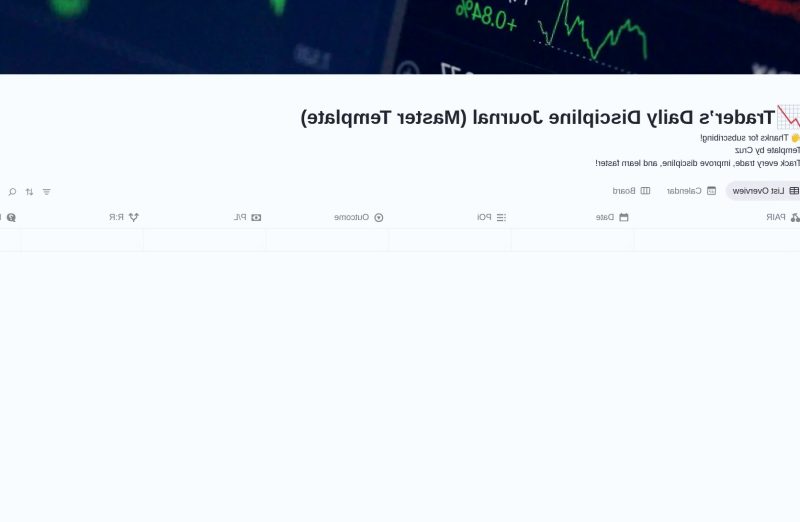
Weekly: Pattern Spotting
Sunday evening or Monday morning, before the Asian session opens. Twenty minutes. Read through the week entries — not to calculate profit and loss, your platform already did that — but to look for patterns in your behaviour.
Start with timing. Did you trade every day, or did your activity cluster? Many traders find their losses concentrate on Fridays, when they force trades to “end the week strong.” Others discover they are most profitable on Tuesdays and Wednesdays when they are fresh and focused, and their Thursday trades are weaker. Your broker will not tell you this. Your journal will.
Look at your emotional state entries. Were your worst outcomes preceded by entries marked “frustrated” or “bored”? Were your best outcomes preceded by “calm” or “patient”? The correlation is often strong enough to be actionable within the first month. If 80% of your losing trades were entered while frustrated, the solution is not a better strategy — it is a rule that you do not trade while frustrated.
Check whether you followed your own rules. Did you honour your stops, or did you move them? Did you exit at your targets, or did you close early out of anxiety? The weekly review is not about the market. It is about you.
Monthly: Strategy Assessment
At the end of each month, calculate four numbers:
– Win rate: divide winning trades by total trades
– Average winner: the mean profit of your winning trades in pips
– Average loser: the mean loss of your losing trades in pips
– Expectancy: (win rate times average winner) minus (loss rate times average loser)
This tells you what a typical trade is worth, on average, over time.
Most traders have never calculated their expectancy. They have a vague sense based on their account balance trajectory, which is influenced by position sizing, deposit timing, and selective memory. The actual number is often surprising. Traders who feel profitable sometimes have negative expectancy being masked by one or two outsized winners. Traders who feel mediocre sometimes have positive expectancy being eroded by inconsistent position sizing.
Compare these numbers against your strategy theoretical parameters. If your system is designed around a 1:2 risk-reward ratio, is that what your journal data shows? Many traders design for 1:2 and execute at 1:1.3 because they take profit early or let losers run past their stops. Strategic drift is almost invisible without monthly data. It happens slowly — a stop moved here, an early exit there — until the strategy you are trading bears little resemblance to the one you tested.
Quarterly: The Honest Audit
Three months of data is the minimum for honest conclusions. Less than that and you are reading noise. At the quarterly mark, your journal contains enough trades to distinguish between patterns and coincidences.
The first question is binary: are you consistently profitable, or is one large winner masking a series of losses? Plot your equity curve from the journal data — not your account balance, which includes deposits and withdrawals, but the cumulative P&L from traded entries only. A smooth upward curve suggests a working system. A flat line punctuated by spikes suggests you are gambling with occasional luck. A downward curve with the occasional spike up is the most common and the most dangerous, because the spikes sustain the belief that “the approach works, I just need to execute better.”
Which pairs produce your best risk-adjusted returns? If you trade NZD/USD, NZD/AUD, and NZD/JPY, your journal will almost certainly show that one of these pairs accounts for a disproportionate share of your positive expectancy. That information has direct practical value: weight your trading toward it. Reduce exposure to the pairs where your track record is weakest, even if you enjoy trading them. Enjoyment and profitability are not the same metric.
Patterns Your Journal Will Reveal
The Session Bias You Didn’t Know You Had
NZ-based traders have a particular vulnerability to session timing effects, and most do not realise it until the journal makes it undeniable.
The Asian session — roughly 8am to 5pm NZST — is the natural window for a Kiwi trader with a day job to monitor positions. It is also when NZD pairs see their first liquidity of the day and when RBNZ announcements land. Many NZ traders do their best work here because they are alert, focused, and trading in conditions they understand intuitively.
The temptation comes at 9pm or 10pm NZST, when the London session opens and volatility picks up. The NZD/USD spread tightens, the candles get bigger, and it feels like where the real trading happens. And it might be — but your journal will likely show that your 10pm trades perform significantly worse than your 10am trades. Not because the London session is harder, but because you are tired after a full day of work, your decision quality is degraded, and you are more susceptible to impulse entries.
This is not a universal truth. Some traders genuinely perform better in the London overlap, and the journal will show that too. The point is not that one session is objectively better. The point is that your session has measurably different results, and trading without that data is trading with a self-imposed handicap.
The Revenge Trade Signature
Revenge trading leaves a distinctive fingerprint in journal data, and once you see it, the pattern becomes impossible to ignore.
The signature looks like this: a stop-out, followed by a new entry within 10 to 20 minutes on the same pair or a correlated pair, with position size equal to or larger than the losing trade. The reasoning field, if it is filled in at all, is notably thinner than usual — “reversal looks likely” instead of the structured analysis that characterises your better entries. The emotional state field, if you are honest, reads “frustrated” or “determined,” which in trading contexts mean the same thing.
The cost is quantifiable. Pull every trade from your journal that matches this pattern and calculate the win rate separately. For most traders, revenge trades win at 25% to 35% — dramatically below their overall average. The position sizing is larger, so the losses are larger. The net effect is that three or four revenge trades per month can erase weeks of disciplined work.
The fix is mechanical: a mandatory cooling period after any stop-out. Some traders set it at 30 minutes. Others ban themselves from re-entering the same pair for the rest of the session. The specific rule matters less than having one, and it is much easier to enforce when you can show yourself the data on what happens when you do not.
The Trades You Should Be Taking More Of
Journals have a reputation as diagnostic tools — instruments for finding what is wrong. That is half the picture. After three months of data, most traders discover something they are doing unusually well, and that discovery is worth more than any correction.
The pattern might be a specific setup. Perhaps your trend-continuation entries on NZD/USD after a pullback to the 20 EMA win at 62% with an average reward-to-risk of 2.3:1 — substantially better than your overall numbers. Or perhaps your trades during the first hour of the Asian session outperform everything else by a wide margin. Or you might find that your fundamental-driven trades around dairy auction results produce better expectancy than your purely technical entries.
Whatever the pattern, it represents something you have a genuine feel for — a convergence of your analytical strength, your risk tolerance, and the market conditions you read most accurately. Without the journal, this edge stays invisible, buried in the noise of your overall trading. With the journal, it becomes a foundation for specialisation.
The practical step is straightforward: once you identify a high-expectancy setup or condition, restructure your trading week around it. Reduce or eliminate the trade types that drag your numbers down. Increase your exposure to the configurations where you demonstrably outperform. Your journal turns an instinct into evidence, and evidence into a plan.
The best traders we know do not journal because someone told them to. They journal because they tried it, saw their own patterns laid bare in data, and could not go back to trading blind. The discomfort of writing down a bad reason for a trade lasts three minutes. The cost of repeating that trade without ever examining it compounds for years.