 Smart
SmartMost forex strategy content assumes you trade from a London or New York desk, which is about as useful to a Kiwi trader as a snow tyre recommendation. NZ-based traders operate in the Asian session by default — a timezone where NZD/USD often range-trades for hours, but where NZD/JPY and NZD/AUD offer genuine price discovery.
Domestic data releases provide an informational edge that London traders simply do not have at 10:45pm their time.
What the Asian Session Actually Looks Like for NZD

Session Boundaries in NZ Time
Most forex education material defines the Asian session as 9am to 6pm Tokyo time, which is helpful if you live in Tokyo and largely useless if you are sitting in Auckland. Here is what it looks like from this side of the dateline.
During New Zealand Standard Time (NZST, April to September), the Asian session runs roughly from 8am to 5pm NZT. Sydney opens at 9am NZT, Tokyo at 11am, and there is a Sydney-Tokyo overlap from 11am to 5pm that represents the highest-liquidity period of the Asian session. During NZ Daylight Time (NZDT, October to March), everything shifts an hour earlier because NZ moves its clocks but Japan does not — Tokyo opens at 10am NZT, and the overlap runs from 10am to 4pm.
Australia complicates this further. Most of Australia observes daylight saving but on a different schedule from NZ, and Queensland does not observe it at all. The practical effect is that the Sydney-NZ time gap shifts by an hour twice a year, and not always on the same dates.
The late US session overlaps with the very start of the NZ day. If you are an early riser, the last hour of NY trading (approximately 7-8am NZST) can produce sharp moves on NZD pairs as US traders close positions. This is a window that most Asian session guides overlook, and it is particularly relevant for NZ traders who check their screens before breakfast.
Liquidity Is Not a Constant
Spreads on NZD pairs follow a predictable daily cycle, and understanding it saves money. The widest spreads occur in the hour between the NZ market opening and the Sydney open — a window where liquidity is genuinely thin and your broker compensates by widening the bid-ask gap. On NZD/USD, you might see spreads of 1.5 to 2.0 pips during this dead zone compared to 0.8 to 1.0 pips during the Sydney-Tokyo overlap.
For scalpers and short-term traders, this matters enormously. A scalper targeting 10-pip moves pays 15-20% of their target in spread costs during early Asian hours versus 8-10% during the liquid overlap. Over hundreds of trades, that difference compounds into a measurable drag on returns. If your strategy requires tight spreads to work, confine your trading to the overlap period.
Swing traders holding positions for days or weeks can afford to be more relaxed about session spreads. The entry cost is a one-time expense, and a 0.7-pip difference is noise on a 200-pip swing target. Where it still matters is stop placement: a wider spread means your stop is effectively closer to the market. Set stops a few pips wider during early Asian hours to account for the spread differential, or simply wait for the overlap before entering.
The lowest spreads for NZD pairs occur during the London morning (midnight to 7am NZT), when most NZ traders are asleep. This is the fundamental timezone disadvantage of trading from New Zealand, and there is no clever workaround — it is simply a cost of geography.
The NZ Data Window: 8:45am and the RBNZ
Here is where NZ-based traders hold a genuine edge: when domestic data drops, you are awake and at your screen.
Stats NZ releases most economic data at 10:45am NZT — GDP, CPI, employment, trade balance. The RBNZ announces OCR decisions at 2pm on scheduled dates, with the Monetary Policy Statement following. Both fall squarely in the Asian session and both move NZD pairs immediately. A trader in London sees these releases at 9:45pm and 1am respectively — hardly prime trading hours.
The NZD reaction to domestic data follows reasonably consistent patterns. CPI surprises generate some of the largest moves because they directly influence OCR expectations. A CPI reading 0.2% above consensus can move NZD/USD 40-60 pips in the first fifteen minutes, often with a sharp initial spike followed by a partial retrace. Employment data tends to produce a more measured reaction, with the move developing over an hour rather than a few minutes. GDP surprises move the currency but less sharply than you might expect — the data is backward-looking and often partially priced in from earlier indicators.
RBNZ decisions are in a category of their own. A rate change that matches expectations produces minimal movement. A surprise hold, cut, or hike can generate 80-100 pip moves in seconds. The accompanying statement and forward guidance often matter more than the decision itself — a hold with hawkish language can move NZD as much as an actual hike.
Position sizing around data releases is critical. If you are new to it, start with half your normal position size until you develop a feel for how quickly and how far these releases push the Kiwi.
Which Pairs Move and Which Just Sit There
NZD/JPY and NZD/AUD: The Asian Session Naturals
NZD/JPY and NZD/AUD are the pairs that genuinely trade during Asian hours, because both counter-currencies have active domestic markets operating at the same time.
NZD/JPY benefits from Tokyo being the largest forex centre in the Asian timezone. Japanese institutional investors, exporters, and the BOJ itself are active participants, generating real two-way order flow. The pair typically moves 40-70 pips during the Asian session, with larger moves when BOJ officials comment on monetary policy or when Japanese data surprises. Chinese data releases also drive NZD/JPY because both currencies respond to shifts in Asian risk sentiment, though in opposite directions — NZD weakens and JPY strengthens during risk-off events.
NZD/AUD benefits from the tight economic relationship between the two countries and the Sydney market overlapping with NZ hours. The pair is sensitive to relative data surprises — if Australian employment comes in strong while NZ data is soft, NZD/AUD will move. Typical Asian session ranges are narrower than NZD/JPY, usually 25-45 pips, reflecting the high correlation between the two economies.
Both pairs offer something NZD/USD cannot during Asian hours: genuine price discovery rather than marking time. If you are a NZ-based trader who wants to trade actively during your working day, these are the pairs that reward attention.
NZD/USD: Treading Water Until London Wakes Up
NZD/USD is the most-traded Kiwi pair globally, but during the Asian session it often does very little.
The reason is structural. NZD/USD is a cross between a small commodity currency and the world reserve currency. The NZD side generates flow during Asian hours through NZ data and local market activity, but the USD side is largely dormant — US markets are closed, US data is not being released, and the Federal Reserve is not making announcements. The result is a pair that tends to consolidate within a 20-30 pip range during the Asian session, occasionally drifting on NZD-specific news but lacking the momentum that the London or New York session provides.
This creates a trap for breakout traders. Asian session consolidation patterns on NZD/USD look like setups — tight ranges, contracting Bollinger Bands, declining ATR — but the breakout typically does not arrive until London opens. Traders who enter breakout positions during Asian hours end up sitting in a range-bound position, paying spread and swap, waiting for a move that comes six hours later.
The exceptions are worth noting. NZ economic data releases drive genuine Asian session moves in NZD/USD. Chinese data surprises move it too, because China is NZ’s largest trading partner and any shift in Chinese demand expectations reprices the NZD. And occasionally, a late US session development will carry momentum into the early Asian session. But these are exceptions, not the norm.
The China Factor: When Beijing Moves the Kiwi
China is NZ’s largest export market, with dairy products making up a substantial portion of that trade. When Beijing publishes data that changes the outlook for Chinese demand, the NZD responds — and it responds during Asian hours when NZ traders are at their screens.
The most impactful Chinese data for NZD is the manufacturing PMI, released on the last day of each month (typically around 1:30pm NZST). A reading above 50 signals manufacturing expansion and is broadly positive for NZD because it implies continued Chinese demand for NZ exports. The Caixin manufacturing PMI, released the following day, sometimes moves markets further if it diverges from the official reading.
Chinese trade balance data matters because it captures actual import volumes, including NZ dairy and meat products. A strong Chinese import number supports the NZD narrative. GDP releases, quarterly, tend to be less market-moving because Beijing GDP figures are widely suspected of being smoothed, and the market focuses on higher-frequency indicators instead.
PBoC announcements — rate changes, reserve requirement adjustments, yuan fixing surprises — can generate sharp NZD moves. The transmission mechanism runs through commodity currencies broadly: when the PBoC eases policy, it signals either economic weakness (NZD negative) or stimulus-driven demand recovery (NZD positive). The market interpretation depends on context, which is why we watch the sequence of releases rather than reacting to any single number.
For practical purposes, flag the Chinese data calendar alongside the NZ calendar at the start of each month. The two together define the domestic-session catalysts that move NZD pairs.
Strategies That Suit the Asian Session
Range Trading NZD/USD: Playing the Box
NZD/USD range-trades during Asian hours often enough that a structured range strategy makes sense — provided you recognise the days when it will not work and step aside.
The approach starts at the Asian session open. Identify the range established during the final two hours of the US session (roughly 6-8am NZT). This is your initial reference box. NZD/USD will often test the upper and lower boundaries of this range during Asian hours without breaking through. A buy order near the lower boundary with a stop 15-20 pips below, and a sell order near the upper boundary with a stop 15-20 pips above, captures the mean-reversion tendency of this pair during low-liquidity hours.
Position sizing should reflect the modest target. A 20-30 pip range means your profit target per trade is 10-20 pips — small by swing trading standards. The risk-reward ratio only works if your stop is tight enough and your win rate is high enough. On calm days with no scheduled NZ data, win rates above 60% are achievable. On data days, the range breaks and the losses can exceed multiple winning trades.
This is the critical filter: do not range-trade NZD/USD on mornings with scheduled NZ economic releases (CPI, GDP, employment, RBNZ decisions). Do not range-trade on mornings after a significant US event (FOMC, Non-Farm Payrolls) because the move may still be playing out. Check the calendar before you set orders.
News Trading the Domestic Calendar
Trading NZ data releases is one of the few genuine informational advantages available to retail traders based in this country. You are awake, you know the local context, and you have had your coffee.
The tradeable NZ data releases fall into three tiers:
– Tier one: RBNZ OCR decisions (80-100 pip potential moves), CPI (40-60 pips), GDP (30-50 pips)
– Tier two: employment data (25-40 pips), trade balance (15-30 pips)
– Tier three: building permits, retail sales, migration data (10-20 pips, often fading quickly)
For tier one and two releases, a straddle approach works reasonably well. Set a buy stop 15-20 pips above and a sell stop 15-20 pips below the current price, five minutes before the release. Whichever direction the data pushes, one order triggers. The stop on the triggered order sits at the other side of the pre-release price. The untriggered order acts as your stop loss — cancel it once one side triggers.
The risk is a whipsaw: the initial spike triggers one order, reverses, triggers the other, and you take two losses. This happens most often on tier three releases where the move is not strong enough to sustain. Restricting straddles to tier one releases reduces whipsaw risk because the initial moves are larger and more directional.
After a data release, the first move is not always the final move. A strong CPI reading might spike NZD/USD 40 pips in five minutes, then retrace half that move over the following hour as the market digests the implications. Taking partial profits on the initial spike and trailing a stop on the remainder captures both the impulse and the potential continuation.
Managing the London Open from the Wrong Side of the Clock
The London Open Gap: What Happens While You Sleep
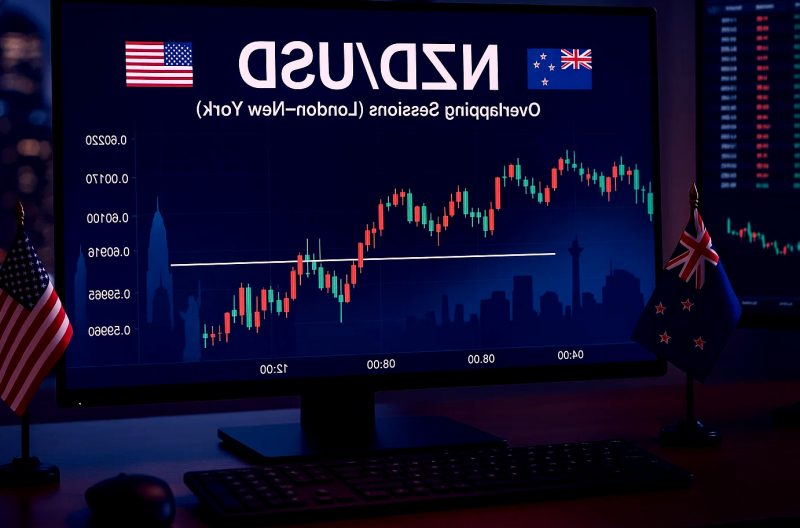
The London session open is the single most important daily event for NZD/USD, and for NZ traders it happens around midnight. This is when liquidity floods into the market, institutional desks come online, and the Asian session range either extends or reverses.
Two patterns dominate the London open for NZD pairs. The first is the Asian range breakout: London traders assess the overnight range and push through one side, triggering stops placed by Asian session traders. If NZD/USD consolidated between 0.5920 and 0.5950 during the Asian session, London might push it to 0.5910 or 0.5960 within the first hour. The breakout direction often depends on the broader trend and any overnight news flow.
The second pattern is the Asian session reversal. If NZD moved in one direction during Asian hours on light volume, London occasionally fades the move — interpreting it as positioning in thin liquidity rather than a genuine trend. This is particularly common when the Asian session move lacked a clear catalyst.
For NZ traders heading to bed, the London open is a risk management event. If you hold positions into London hours, you are holding through the highest-volatility transition of the day without being at your screen. Some traders treat this as a non-negotiable reason to be flat before midnight. Others accept the risk and use conditional orders to manage it. Neither approach is wrong, but the choice should be deliberate.
Protective Orders for Overnight Positions
Holding NZD positions through the London and New York sessions while you sleep is unavoidable if you swing trade or hold carry positions. The question is not whether to hold overnight but how to protect the position while you are away.
Standard stop-loss orders are the minimum. Set them before you step away, no exceptions. The stop should reflect the volatility of the upcoming session, not the volatility of the Asian session you just traded. A stop that looked comfortable during a 30-pip Asian range is dangerously tight when London opens and the pair moves 60 pips in the first hour.
Guaranteed stop losses, offered by some NZ-accessible brokers regulated by the Financial Markets Authority, eliminate slippage risk in exchange for a wider spread or premium. During high-volatility events — FOMC decisions, Bank of England announcements, ECB meetings — standard stops can slip significantly. A guaranteed stop executes at exactly the price you set.
Trailing stops offer a middle ground for trending moves. If your position moves into profit during the early London session, a trailing stop locks in gains while giving the trend room to develop. Set the trail distance at 1.5 to 2 times the average hourly range of the pair during London hours. Too tight, and normal volatility takes you out. Too wide, and the stop does not protect meaningful profit.
The conservative option — being flat before midnight — is underrated. Trading is a long game, and sustainable routines matter more than capturing every pip.
Building a Routine Around NZ Market Hours
A trading routine built around NZ market hours acknowledges a simple fact: you cannot watch every session, and trying to do so is a recipe for burnout and poor decision-making.
The morning starts with context. Between 7 and 8am, review what happened during the London and New York sessions overnight. Check how far NZD pairs moved, whether any key levels were broken, and what drove the moves. Your broker platform or a tool like TradingView shows the overnight candles; a five-minute review sets the frame for the day. Flag any NZ or Chinese data scheduled for today.
Your primary trading window runs from about 9am to 2pm, covering the Sydney-Tokyo overlap and any NZ data releases. This is when NZD pairs are most liquid within your timezone, when NZ-specific catalysts occur, and when you have the sharpest concentration. Most of your discretionary trading decisions should happen in this window.
From 2pm to 5pm, activity quiets as Tokyo winds down. This is a good window for reviewing open positions, adjusting stops, and setting any conditional orders for the London open. Chinese data releases that fall in this period deserve attention, but otherwise, the sharp edge of the trading day is behind you.
The evening, from 5pm onward, is for preparation rather than trading. Review the London session calendar, decide whether to hold or flatten overnight positions, set protective orders, and close the platform. The traders who last in this market are the ones who find a rhythm that works with their life, not against it.
Trading from New Zealand means accepting that you will sleep through the highest-volume hours for your currency. That is a constraint, not a defeat.
The Asian session offers enough genuine opportunity — domestic data, yen crosses, China-driven moves — that a disciplined trader working NZ hours does not need to sacrifice sleep or sanity chasing every London candle.